
If you have an iPhone, iPad, or MacBook, then you have probably been pestered by Apple updates more than once. If you have been lucky enough to find a way to ignore the company’s desperate pleas to update your devices, you may be unlucky enough to find your device kind of…stops working. Either way, whether you opt into auto-updates or successfully stave off the onslaught of requests, there is always a distinct chance that the things that make you enjoy your iProduct will irrevocably change, to the detriment of your productivity and maybe even your happiness.
Which is where I’m at with Apple’s recent update to the text reactions in the Messages App. In the middle of the night, under the cover of darkness, on maybe a Tuesday, my phone’s battery and its software updater agreed – “it is time”. And now I have a new UI and a dilemma on my hands. I’m being a little dramatic; software updates probably don’t ruin my life, and I don’t usually mind them at all, but this time it’s different. This time it’s a matter of the heart.
The context:
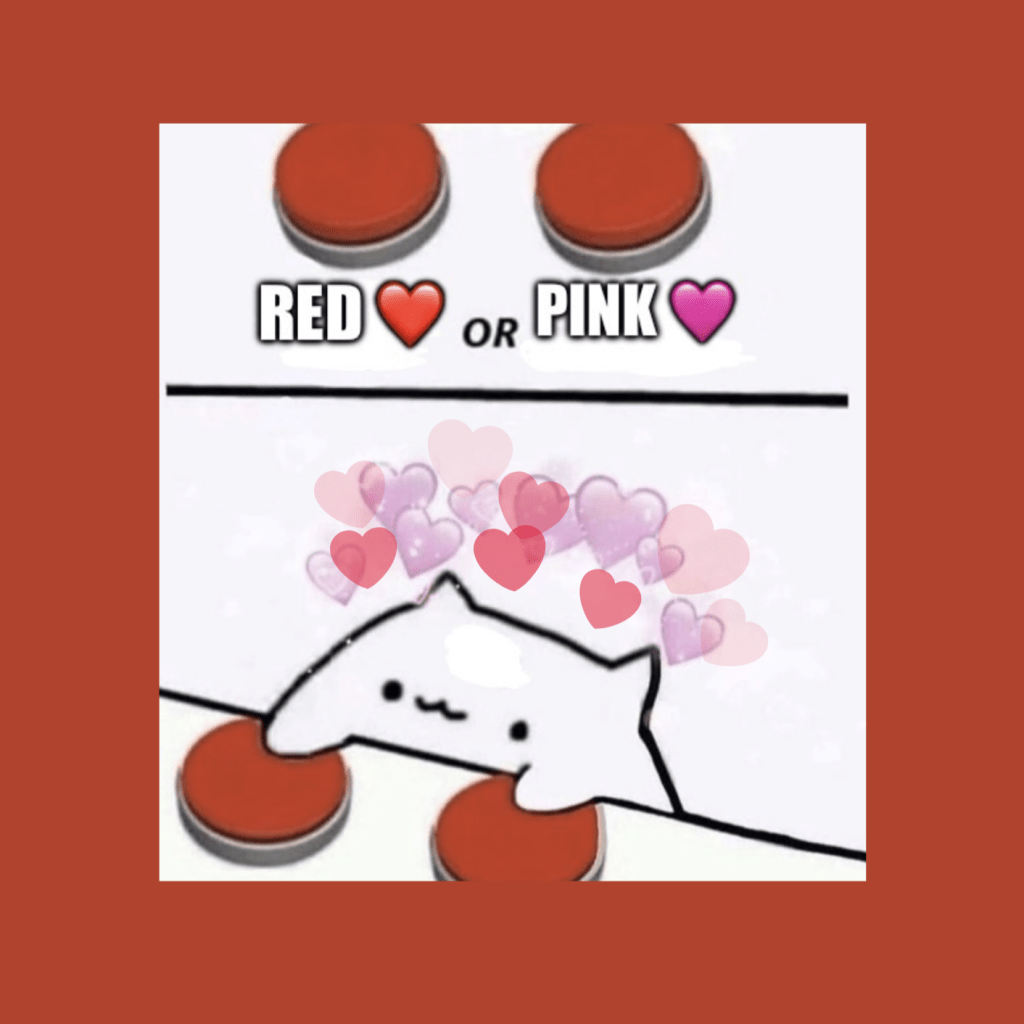
Long-tapping on a text in the Messages app creates a pop-up menu with different ways to react to the content of that text. I am old enough to remember when the only choice was the thumbs-up emoji [👍]. It wasn’t too long before Apple followed up with the additional options to heart [❤️], or “haha” the text. Now, with just one tap, there are a whopping seven emojis to choose from, and an option to open your iPhone’s full emoji library. And all this is all good with me – except for one thing. The seven pop-up reactions now includes two different heart emojis: classic red [❤️] and flirtatiously pink. And that’s one too many in my book.
Now, when we receive a text that we normally acknowledge with a heart, we have to consider which heart. Where there was once one heart, there are two, and they may not be interchangeable. The humanity, the calamity, the ambiguity!
The dilemma:
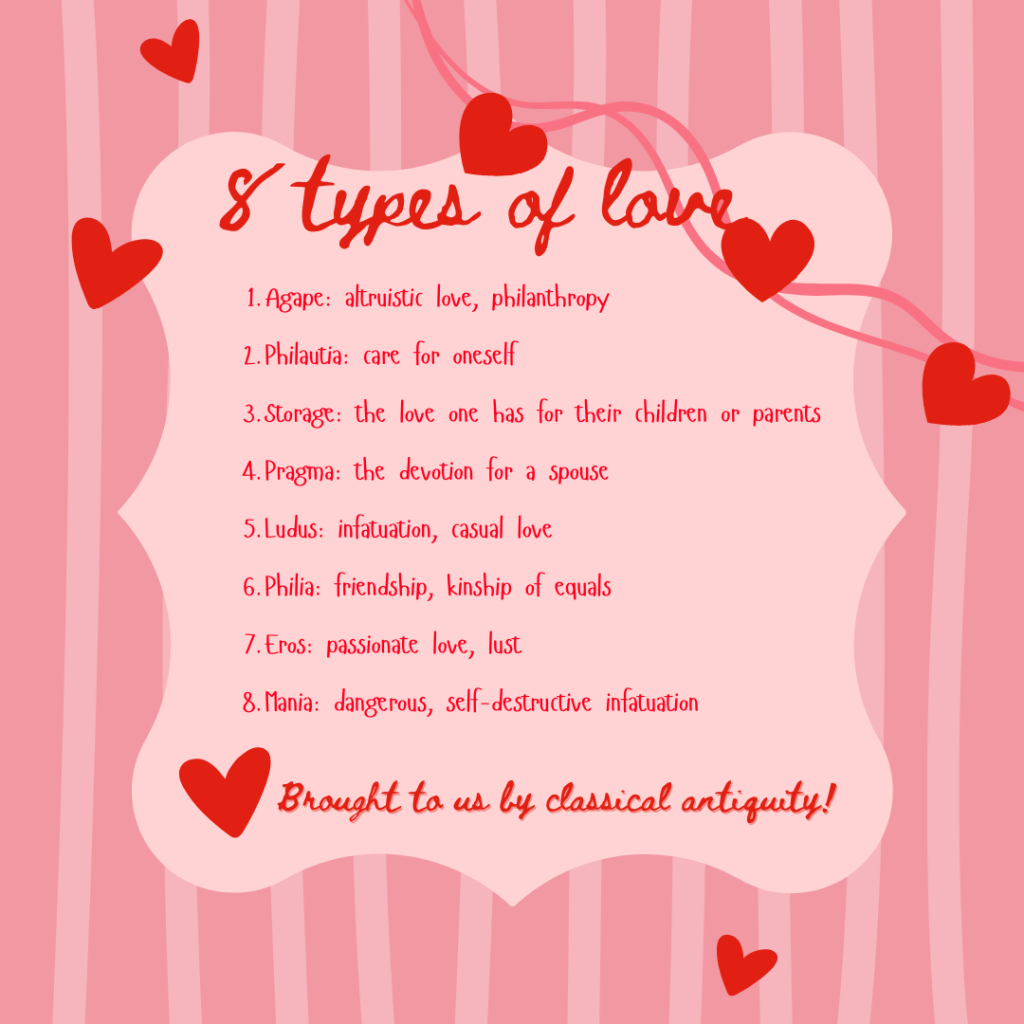
There is more than one type of love – if you don’t believe me, ask the Greeks who have pulled out of their ear at least 8 types of love. Their categories of love range from love of oneself, Philautia, to love for humankind, Agape. Also included in the Greek ethos are a variety of feelings associated with romantic interest, and not all of them are good.
Here lies the main problem with having split our heart emoji in two. With so many types of love, and only two heart emojis – how do we know what kind of love is being expressed in our messages?
Greek mythology, with stories of lustful hookups, amorous deceptions, and legendary partnerships, raises some good questions about the appropriateness of certain feelings of love. In one story, Apollo burns with feelings for the lovely Daphne. So fervently did he pursue her that she fled from him, and when she could not free herself from his impassioned advances, she turned herself into a laurel tree.
Let’s all just sit with that for a moment.
This is, clearly, an example of “bad love.” The Greeks called it Mania, which we recognize from the English word mania, or a type of unbalanced thinking, a symptom of mental illness. Apollo’s love has come to be associated with a health condition, and to be honest, he’s showing signs of needing a doctor’s visit and maybe some medication. Which doesn’t mean he can’t find the love of his life – he just needs to work on himself first.
The nitty-gritty:
This section is a bit abstract. If this is too much nonsense for you, feel free to skip ahead.
Before the introduction of additional hearts, the red heart represented all types of love. The emoji (in semiotics, it might be called a sign or icon) represents all elements of our mental lexicon that we expect a heart emoji to represent. This probably includes things like love, like, agreement, and support. It probably excludes the Greek concept of Mania. For more on set theory, check out this primer.
The contents of our texts already provide the context that automatically filters out inappropriate interpretations of our emoji reactions. In other words, if we aren’t expecting it, we aren’t thinking it. This brings us to what happens when our red heart breaks 💔 in two.
When Apple, Inc. added the pink heart to the lineup of emotes, they split the senses of love, and this is just too much chaos for me to handle. Since I don’t know what to expect, I’m thinking a lot about the two emojis. Every moment that calls for a reaction also calls for a pause to reflect on the implications of my actions. What could I be miscommunicating my feelings to my coworkers, my boss, the H-Vac guy who’s coordinating the annual clean-N-check?
I fear my intuition is outdated, that some meanings I associate with the red heart is now exclusive to the pink heart, or even removed from the set of things a heart emoji can be, and that my social self-esteem lies in the balance.
What if, for instance, the receiver of a heart-react believes the pink heart expresses agreement (“I like this”) and the red heart means “I love this” or worse, “I love you”? What a fumble it would be when I red-heart the H-Vac guy’s text confirming that he will stop in next week to poke around in my pipes! I do not, in fact, love this communication. And it would certainly be more appropriate to pledge my “tepid agreement” instead of my adoration for his statement. On the other hand, if Mr. H-Vac believes the red heart represents detached but friendly agreement, and feels the pink heart is a bit flirtatious, he may be expecting to take a look at more than just your air conditioner. The horrors are real, y’all.
This is why I can’t forgive Apple’s constant requests to change the way I use my device. Communication is hard already! I’m too fragile and tired to withstand more ambiguity in this confusing world we live in!
The solution:
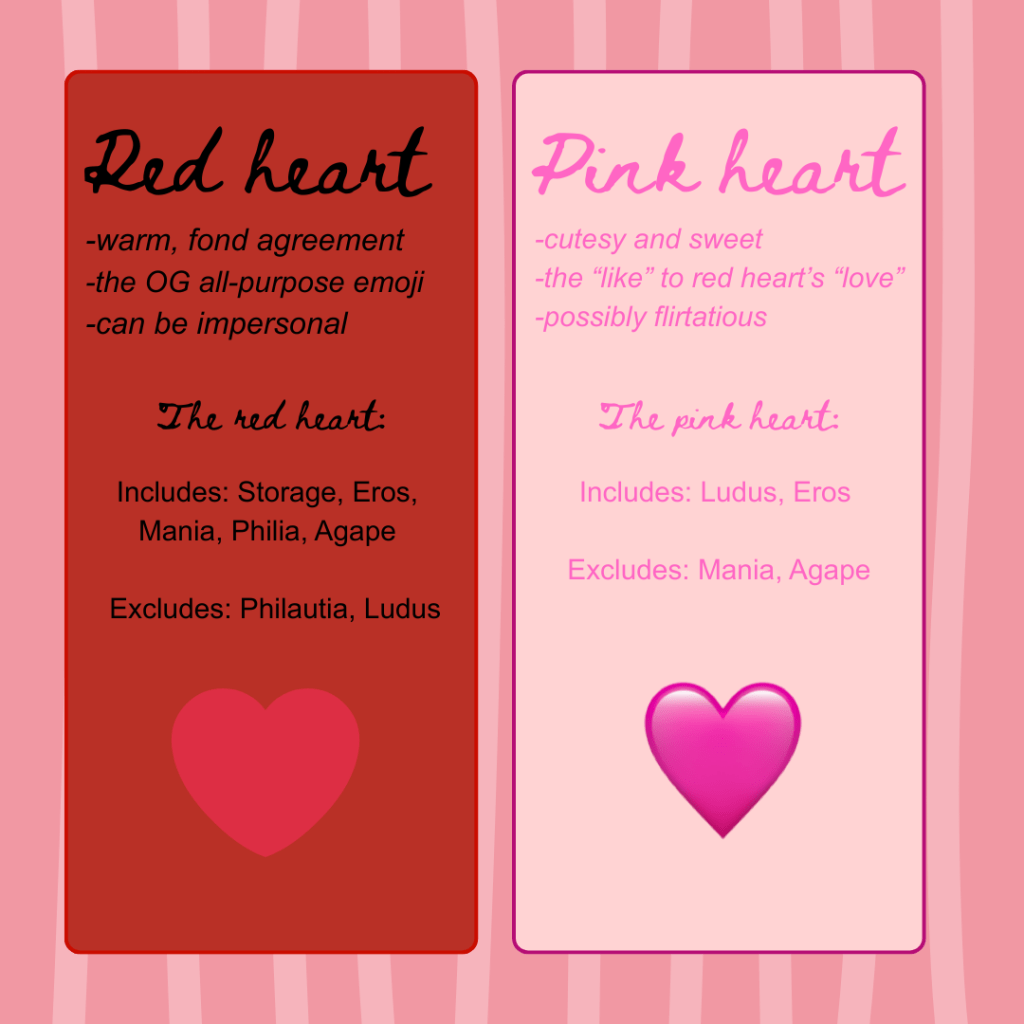
The following is my intuition on what each heart means, what it includes and excludes, using the eight Greek terms for love. I’d love to hear your intuitions on these or any emojis – please share them in the comments!
This has all been a little convoluted, but the good news is that the solution to emoji stress is extremely simple. Just don’t worry about it so much (groundbreaking, I know). After much syntax-related anxiety over the years, I have come to realize that people don’t focus on the little things of language. And, for that matter, I can’t help but notice, I have not once been accused of unintentional coquettishness, rudeness, or any other terrifying breaches of etiquette while heart-reacting to a text. Over time, I’ve come to see that all my fretting is unwarranted. Whether your texting style tends toward casual Ludus, sanguine Agape, or passionate Eros, I hope everyone reading has found their own texting equilibrium.
Still, I will leave you with some unsolicited relationship advice: If you are feeling something is amiss with your loved ones, it can’t hurt to skip the emojis and say it in words!










 Small Words
Leave a comment