
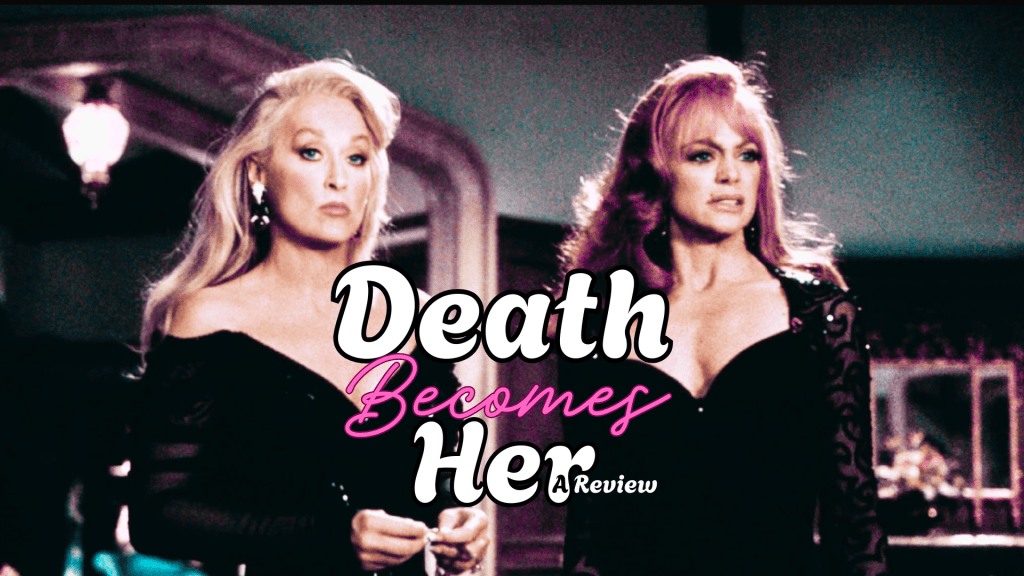
Death Becomes Her (1992) is breathtakingly “the nineties”. It crams a ton of ’90s sensibility into an hour-and-a-half of irreverent comedy. The campy sense of humor, the Home Alone soundtrack, the brown suits, and the brazen raunchiness all scream feature-length films at the end of the millennium.
Also notable is its use of screwball “science” as a storytelling device—a magical force that sparks the plot (think Honey, I Shrunk the Kids) —and this movie really delivers with an elixir of life that packs a punch. It’s hard to tell if the movie thinks science is an Egyptian curse or a brilliant, bold move into the future (think RFK levels of confusion).
This movie tries for a diverse cast – a big surprise considering the era. It has more women than man, a person who is not white, a person who is white but playing a person who is not white, “fat-suits”, and also mentally ill women confined to a psychiatric institution, against their will. Cool. good to see women being supported by the movie industry. A triumph, really. Does not pass the Bechdel test, however – so that’s a frowny face.
(I’m actually kidding; this movie is a standout for being the most obnoxious faux representation I’ve seen.)
Despite all these women, you wouldn’t make a movie without a man, which brings us to the plot, which revolves around a man…
The leading man and love interest is Bruce Willis, who plays a nerdy plastic surgeon named Ernest. You may be surprised to hear ol’ Bruce is not playing the dirt-covered buff beefster that he was so famous for in The Fifth Element, Pulp Fiction, and Die Hard but he achieves the look, quite convincingly, with a pair of glasses and a ‘stache. I completely believed his character was an unattractive putz. And who better to attract two stunning women?
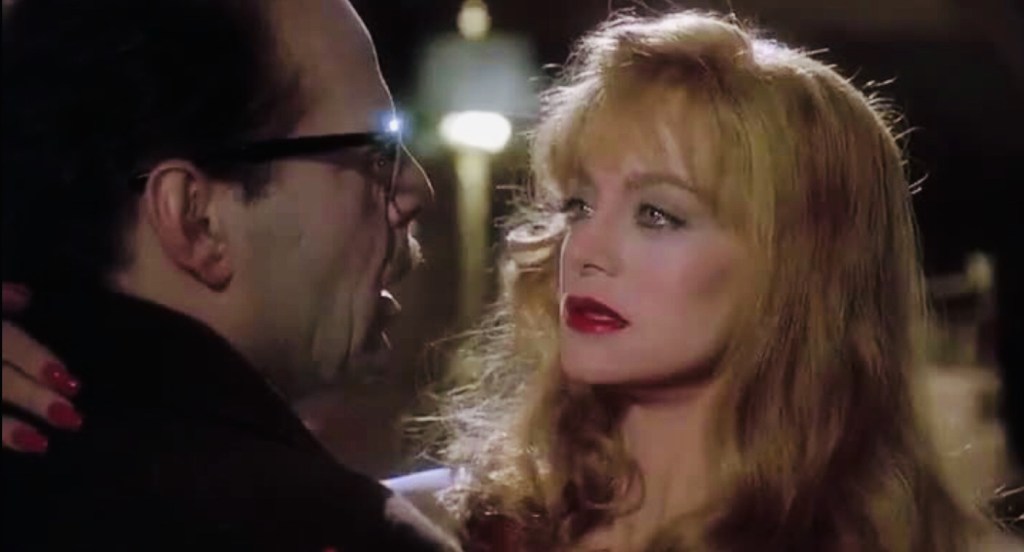
In this movie, Willis is entangled in a love triangle with frenemies Helen and Madeline, played by Goldie Hawn and Meryl Streep. Helen has lost boyfriends to Madeline’s prima donna personality before. When the movie starts, Helen, newly engaged to Ernest, takes him to meet Madeline as a sort of inoculation for the woman’s center-stage charm. Helen thinks that if Ernest meets beautiful Madeline and remains true, then they will live happily ever after.
This is not a happily-ever-after story, however. We do get a wedding but it is Madeline who’s wearing the veil. Helen watches as Madeline and Ernest fold themselves into their car after the ceremony. The camera lingers on Helen’s balled-up fists. She is so angry, her nails bite into the palms of her hands. We see them draw blood and know Helen is silently vowing revenge.
There is a time skip and Helen, torn apart, has sunk into overeating, depression, and her filthy, food-stained recliner chair. For the past years, she has struggled with her mental health and the trauma of her latest lover leaving her for her friend (again). Meanwhile, Ernest and Madeline are feeling unfulfilled in their marriage.
And that’s when the movie really starts. There’s cheating, beheading, cryptic semi-nude women with magic elixirs. Ernest throws Madeline down the stairs – and she gets up. In a show-stopping scene, Madeline, still dazed from her death-defying crash to the bottom of the staircase, and Ernest, who is now very sorry that he tried to murder her, both stare at a recently unconscious Helen arising from a deck pool. Stare “at” is not exactly the right phrase; really, they stare through a hole in Helen’s stomach. Just basically a whole bunch of hijinks, mostly pretty deranged in nature. Feels a little like the product of an unwell mind. Or maybe comes from excitement for new 90s special effects. Who knows.
I’m going to leave the plot points here and discuss what matters most in this movie, its deep sense of morality (sexist morality! the best kind!). This movie is so dogmatic about what sorts of things are no-nos that what sticks with me isn’t the romance or the zany FX, it’s what the movie has to say about living a moral life. In particular, it has advice for husbands and wives on how to get along. Instead of telling us the secret to a happy marriage straight out, it shows us, by example, the sorts of things to avoid (like dumping your fiancée for her friend and then planning to murder your wife to get back with your fiancée). Like, don’t do that guys (!), it seems to say. I don’t think I’ve ever been tempted to, but it’s a nice reminder.
Each character gets the chance to be unlikable. They exhibit a host of vices that are, for some reason, idiotically gendered.
The girls have girl-vices like vanity etc. and the man has man-vices, like lust and “scientific audacity,” the latter of which is mentioned once but not explored. I suppose Ernest is supposed to be sort of a mad scientist but this is kind of lost in all the hair-pulling.
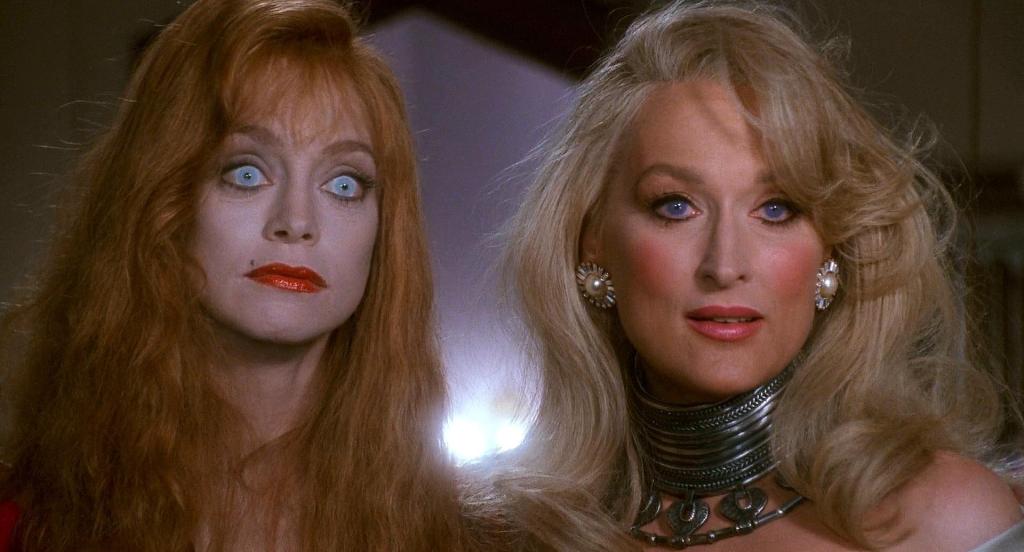
The two leading ladies spend the movie focused on their looks and locked in an ego battle over the least interesting man in the universe. They exhibit any number of objectionable qualities at an intensity that begs for comeuppance. Their main sin is pursuing eternal beauty via a magic potion (it’s all very unnatural so I suppose the narrative thinks it’s extra bad). The potion lifts their butt and bust, it smooths and tucks and it gives them eternal life. In the last scenes, we see that the ladies get a suitable punishment.
For defying the natural ways of youth and god-given beauty (as well as its timer), Helen and Madeline must watch their bodies rot and their beauty dissolve for eternity (at least they keep eternal life!). For being competitive and jealous of each other, they are sentenced to spend their eternity as companions picking each other’s fingers off the floor and stapling them back in the right place. All this doesn’t seem particularly proportional, but we’re borrowing the movie’s moral compass. We’re supposed to think: damn them all to hell, those harlots, but I can’t really get in the spirit of it all.
Meanwhile, Ernest has turned down the elixir of life, left the ladies to their own devices, and built a beautiful life with a happy new family. He dies at a ripe old age and is celebrated for his late-life philanthropy. A man, this film expresses, must turn from the temptation of beautiful women toward the fulfillment of service. Even though all this sounds pious, the movie is indulgently forgiving of Ernest, and to my knowledge, no good works were inspired by this movie.
But it does do an excellent job of showing us what to avoid in our journey through life. Again and again, we are pointed back to how nasty vices can be and how brutal their consequences. Vengeance, jealousy, infidelity, science – whatever base urge you have welling inside, remember, it will come back to you. But more importantly, if you are a boring middle-aged man, Death Becomes Her wants you to walk away knowing that you, too, can survive two drop-dead gorgeous girlfriends!
I’m giving this movie extra credit for its Home Alone music track and its campiness
(and also Meryl’s fabulous, and Goldie is a hoot)
Zero out of five stars











 Small Words
Leave a comment