
Here’s some background and terms:
Election day is November 7th – You can find your polling location [here]
If you are not registered to vote you can register for the next election [here]
- Issue 1 – seeks to amend the Ohio constitution by adding a right called The Right to Reproductive Freedom. This freedom protects access to contraception, fertility-related decisions, abortion with provisions for future restrictions on abortion, and healthcare such as post-miscarriage care.
- An initiative – is a petition to change legislation. Every issue up for vote on the ballot is a type of initiative.
- A ballot summary – is a brief summary of the main points in an issue that will appear on your ballot.
Let’s take a look at the language:
In September the ballot summary for Issue 1 was changed by the ballot committee appointed by the legislature. The final decision about the language can be found [here].
The ballot summary is often the first time we will see the contents of an issue and a biased summary means that we will not know what we are voting for or against. The summary text must be representative, complete, and have neutral wording to give voters a true choice on any issue. It has been claimed that the new wording misrepresents Issue 1 and the changes to the Ohio constitution it proposes. Let’s take a look for ourselves and decide if we agree:
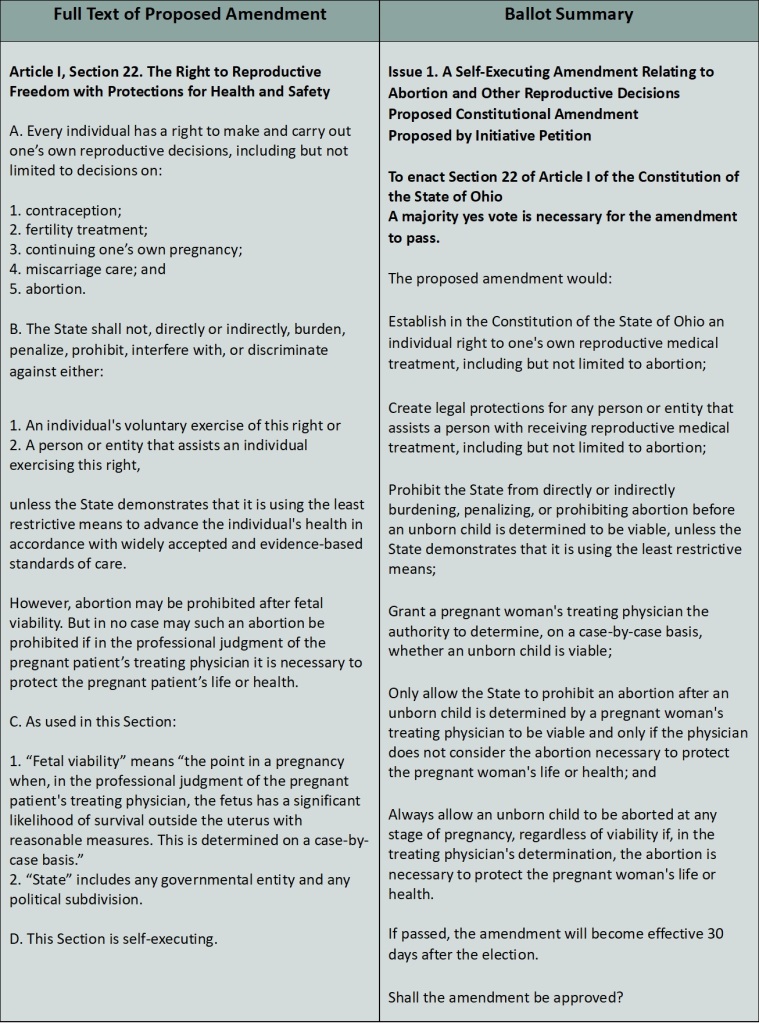
First, we can notice that even when reformatted to save space the summary is actually longer than the full text. So, it seems like the rewrite is not an attempt to save space on the ballot. We can also notice that the summary is very focused on one part of the amendment: abortion. The Issue would seek to protect all “reproductive freedoms” and abortion is not the only one named in the proposed amendment. The others are contraception, fertility treatment, continuing your pregnancy, and miscarriage care. So, even without cutting the length of the original, the summary is not complete. It doesn’t mention the other protections under the amendment. For instance, if Issue 1 is defeated, not only will there be immediate moves to partially or completely ban abortions performed by medical professionals but access to some or all birth control could be restricted.
That leaves all contraception including hormonal birth control (“the pill”), and Plan B vulnerable to lawmakers’ views on when life begins. If they decide life begins when a couple’s gametes “monster mash” (as they say) every one of us is beholden to that interpretation of “life.” And this could create a heightened risk of pregnancy for even the most careful partners.
The summary is also not representative because Issue 1 proposes a new constitutional right for the citizens of Ohio. This gives every man, woman, and child another legal protection from the government. Constitutionally protected human rights are no joke and the more of them we have the less say politicians and lawyers have on how we live our lives. Reducing Issue 1 to abortion misrepresents that this amendment would grant us, the citizens of Ohio, more rights in the eyes of the law.
If reading a ballot summary makes you feel strong emotion it’s probably not doing its job. Law language should be boring and for a good reason. Boring language lets the reader make up their own mind. We are all thinking individuals and as voters, we want the facts! Not anyone’s opinions and feelings on a topic we are all capable of deciding for ourselves. That’s why neutral wording is so important when it comes to ballot language. I have strong negative emotions when I read this summary – we all likely do. And that’s how we know it’s not using neutral wording.
The most obvious example is the use of the term “unborn child” which presumes a lot about a controversial topic. I talk a little more about this use of “child” and why the term “fetus” is more appropriate in this legal context in another post [check it out here]. But vocab aside, the grammar stands out as saying more than what’s actually written in the issue.
When the Issue writes: “abortion may be prohibited after fetal viability” (unless the woman’s health is threatened)
The Summary “paraphrases” it: “only allow the State to prohibit an abortion after an unborn child is determined by a pregnant woman’s treating physician to be viable” (unless her doctor decides it will hurt her health)
Well, these sound like two different statements. Though the summary is based on the words written in Issue 1 it just hits different. The use of “only” vs. “may” falsely communicates to us that the issue is preventing abortion regulation even though it explicitly invites regulation after fetal viability. The summary is riddled with inadequate wording choices and misleading paraphrasing (too many to discuss in just one post!). The revised language is often longer than the original and gives us a very different impression of the contents of the amendment. Not a very good summary in my book.













 Small Words
Leave a comment