
Some Background
Issue 1 seeks to amend the Ohio constitution by adding a right called The Right to Reproductive Freedom. This freedom protects access to contraception, fertility-related decisions, abortion with provisions for future restrictions on abortion, and healthcare such as post-miscarriage care.
The flier (as pictured) is a markup of the full text that will be up for vote in Ohio on November 7th.
Early voting is currently open. Find your polling place [here].
If you aren’t registered to vote yet- You can register [here] for the next election.
Now Let’s Look at the Flier!
Depending on our experience with legal documents these markups may seem reasonable, but I would like to talk about how these comments are carefully curated to mislead. The makers of this mailing are exploiting the likelihood that most of us don’t have a lot of experience with legal language to make us feel like the bill is something it’s not. They use loaded language, inaccurate or extraneous details, and unfounded implications to make us feel we’re reading critical analysis. But they are putting on a show! They probably don’t themselves feel that their markups are a good counterargument for the issue. If these people were to challenge Issue 1 in court, I very much doubt they would use the same language and tactics they use here, for us.

Loaded Language
These markups do a lot of lexical work. The people responsible for designing this mailing spent care on creating impact with each of their words. The picture they paint using markers and highlighters is gruesome, but luckily, it’s also not reality. Replacing “fetus” with “unborn child” and using terms like “abortionist” makes us think of late-term coat-hanger abortions but in fact, the amendment seeks to incentivize safe abortion and leaves a path for lawmakers to immediately outlaw late-term procedures.
The use of the wording “unborn child” is a presumptuous term when we are talking about a pregnancy starting from day one through viability. Not everyone believes in “life at conception” and during the stages of pregnancy where the baby doesn’t resemble anything we would recognize as a baby – there will be contentious debate about this wording. The term fetus may be impersonal and medical, but is neutral to account for these ideological differences. We wouldn’t want doctors, lawyers, and the government presuming the meaning of life, so “fetus” is much more appropriate here. Nevertheless, most people would agree that at some point a fetus does start to resemble a human, and the term “abortionist” preys on our fears that there is a profession of people that singly perform horrible surgeries on errant women. A very grizzly picture! But of course, “abortionist” is a dysphemism for gynecologists, obstetricians, nurses, and people who devote their lives to the health of women. Calling the trained professionals who provide abortion care “abortionists” is like calling a psychiatrist a lobotomist. Reducing a respected profession to the most unattractive aspects is obviously very silly.
Inaccurate or Extraneous Details
At the top of the document the makers of the leaflet point out that Article 1 is actually called The Bill of Rights. Which is true! This amendment is proposed to be added in Article 1 of the Ohio Constitution under the section called “The Bill of Rights.” So, the two headers are synonymous. As sick a brag as knowing two names for something is, it’s fully extraneous information. This addition adds no value to the original and appears to be included in the markup to establish phony credibility for the makers of the leaflet and baselessly undermine the amendment as a whole.
When we were in school, we likely pored over the original US Constitution, signed in 1787 but law language is unsurprisingly very different these days. When the leaflet highlights and “corrects” the proposed amendment wording with antiquated terms from the US Constitution like “shall not”, I have to laugh. It’s not 1787 anymore and lawyers these days try to write in everyday language. They presumably include this correction to sound cool like the founding fathers and cast doubt on the drafters of this amendment but it makes me question whether they know anything about legal documents at all, or whether they are pretending not to.
It’s suspicious that the makers of this flyer, who seem so interested in law and have an organization financing and printing high-quality glossy prints to send around the entire state of Ohio, don’t know about law language. So suspicious that I can’t shake the feeling they do know a lot about law. In fact, they may just be lawyers themselves. Though they seem to be making silly irrelevant points their pedantry is intended to gain them credibility. And with that credibility, they can more easily manipulate and misinform us, the reader.
Unfounded Implication
When it comes to controversial topics, it is easy to exploit a very human tendency to respond to the unknown with fear. This mailing makes multiple attempts at portraying an ominous future to scare us into thinking there is more in the amendment than meets the eye. The points they bring up are pretty feeble though. My favorite markup is a note on the right of the document set off in red ink. It simply says “cloning” and looks stranded. Visually this note does its job because it guides the eye to some pretty astonishing phrases.
Such as… “harvesting body parts”? Oh, my!
Can’t say I’ve ever seen that phrase taken so seriously, but here we are. Their claim is that the wording “including but not limited to”, which proceeds the list of protected reproductive care, secretly means “without limits”. and therefore, unleashes a whole world of reproductive mayhem on Ohio. But all of these implications are pretty far-fetched. In the world we live in it’s extremely unlikely that there will be cases that use this amendment to legalize, for instance… harvesting body parts (oh dear!)
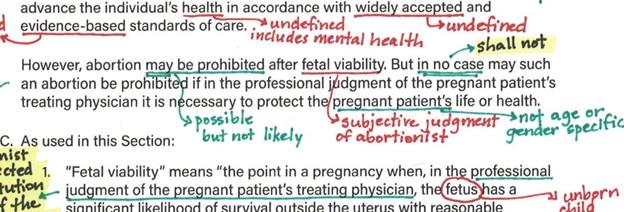
This isn’t the only time the makers of the mailing criticize the proposed amendment for vagueness. They point out multiple times that terms are not defined or specific enough for their liking. Law that is too explicit and restrictive can have strange results, and if law isn’t explicit enough it will fail to uphold the freedoms it was written to protect. For example, if the amendment language, drafted by people who are trained in law, were to define the term “fetal viability” with exacting specificity, we would have an inaccurate definition of “fetal viability.” Each woman, each womb, and each baby has a different point of viability. Law has to allow for each case to be reviewed individually with all facts taken into consideration. Instead of making a guess, Issue 1 considers a baby viable when the woman’s doctor and medical science say it is. Not when a lawyer does.
But it is a balance, Issue 1 also has to be explicit where it’s important. Unsurprisingly, the mailing has gripes with this too. When the amendment says “but in no case” can abortions be restricted when a woman’s life is threatened by continuing the pregnancy, it is clear.
This language intends to protect women who have vulnerable health and prevent some of the most egregious casualties of abortion bans and if the issue passes it will. When the makers of the mailer discredit this wording they know that they are targeting one of the best arguments against the morality of abortion bans. As we know morality is a really big part of a pro-life stance. The makers of the mailer can’t afford to let the wording stand for itself so they add a lot of visual clutter and objections that just don’t make a lot of sense.
Take away
This leaflet wasn’t really supposed to be read. The way it looks, riddled with red underlines and comments,is enough to give us the feeling that Issue 1 is flawed. So flawed that if this were a school paper you would be lucky to pass the assignment.
We also get the sense that we’re not supposed to have the full text of the proposed amendment. The makers of the mailing probably wouldn’t mind us thinking they’re some sort of vigilante courthouse crusaders. But I highly doubt they are breaking into law libraries and taking surreptitious pictures of the original document. Besides, why would they be sneaking around in the dead of night when you can get the full text [here]?
If we do read the comments and “corrections,” we will find that the makers of the mailing attempt to stoke our imagination with mostly unrelated ideas in hopes that we’ll follow them to an extreme and unrealistic conclusion. They send us down a path to a sci-fi hellscape where cloning is scientifically viable and unopposed by the national government, where sexual education is about teaching kids to be good in bed, and where all abortion care means back-alley abortions performed by corrupt sentient squirrels… with rabies… or something. Idk what’s in peoples’ heads.
But in reality, this amendment creates constitutional protection for access to contraception, abortion services, and the doctors and nurses who provide women’s healthcare services. Pretty simple. The amendment is certainly not hiding as much as this markup.














 Small Words
Leave a comment